




NumSharp (NS) is a NumPy port to C# targetting .NET Standard.
NumSharp is the fundamental package needed for scientific computing with C# and F#.
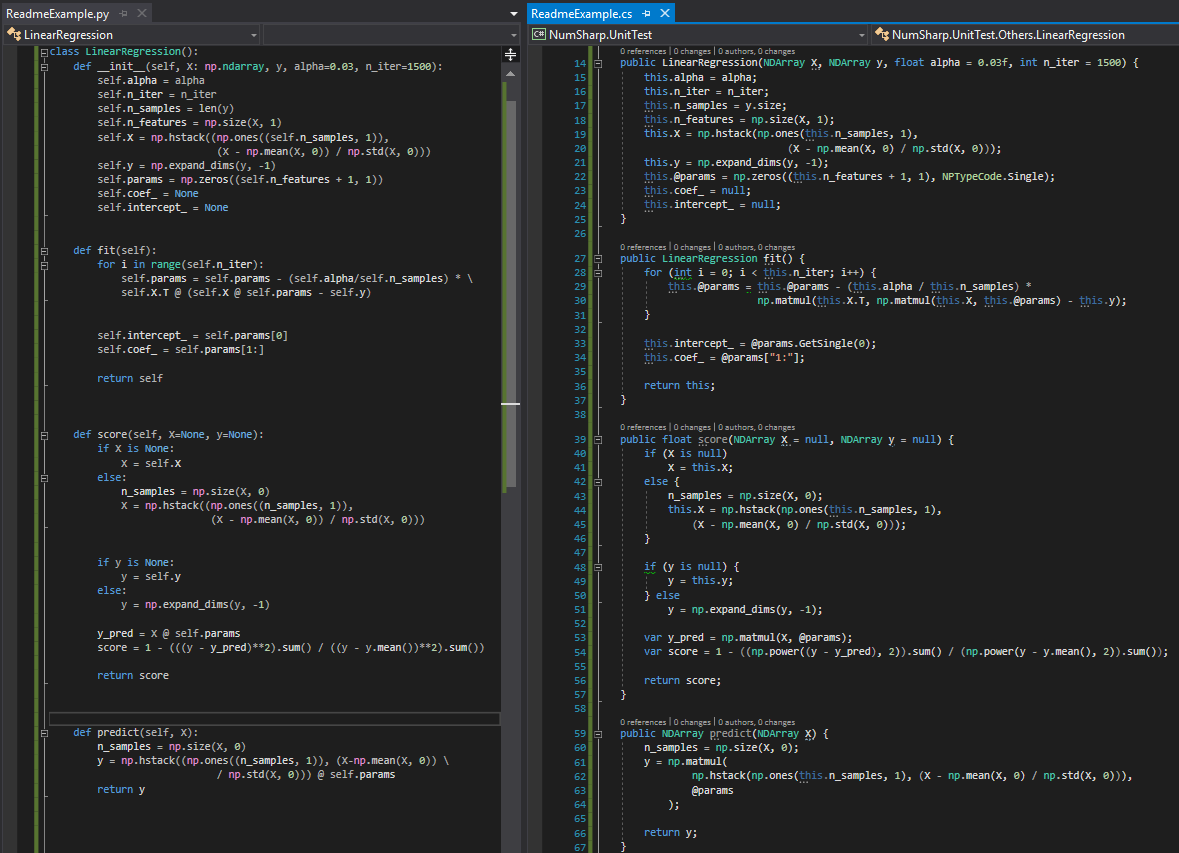
Is it difficult to translate python machine learning code into .NET? Because too many functions can’t be found in the corresponding code in the .NET SDK. NumSharp is the C# version of NumPy, which is as consistent as possible with the NumPy programming interface, including function names and parameter locations. By introducing the NumSharp tool library, you can easily convert from python code to C# or F# code. Here is a comparison code between NumSharp and NumPy (left is python, right is C#):
- Use of Unmanaged Memory and fast unsafe algorithms.
- Broadcasting n-d shapes against each other. (intro)
- NDArray Slicing and nested/recusive slicing (
nd["-1, ::2"]["1::3, :, 0"]) - Axis iteration and support in all of our implemented functions.
- Full and precise (to numpy) automatic type resolving and conversion (upcasting, downcasting and other cases)
- Non-copy - most cases, similarly to numpy, does not perform copying but returns a view instead.
- Almost non-effort copy-pasting numpy code from python to C#.
- Wide support for
System.Drawing.Bitmap. (read more)
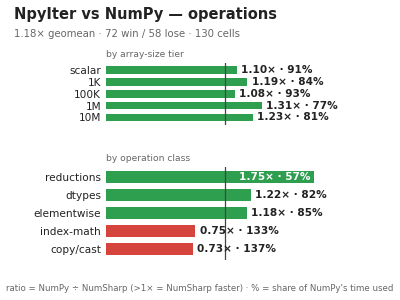
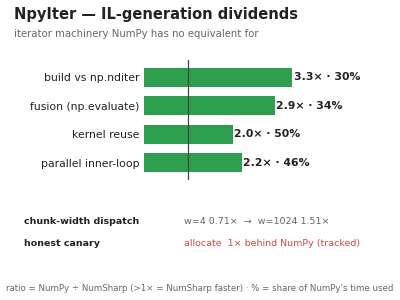
NumSharp's NumPy-aligned iterator (NDIter) benchmarked against NumPy 2.x. The left card is the head-to-head comparison — geomean speedup by array-size tier and by operation class. The right card is the IL-generation dividend: iterator machinery NumPy has no equivalent for — cheaper construction than np.nditer, one-pass expression fusion, kernel reuse, and a parallel inner loop. Bars are NumPy ÷ NumSharp on the same machine (>1× = NumSharp is faster), and each also shows %NumPy🕐 — the share of NumPy's time NumSharp uses (56% = takes just over half as long; <100% = faster). Absolute timings vary by hardware, so only the same-runner ratio is meaningful.
Refreshed automatically after each release. Full report →
The NumPy class is a high-level abstraction of NDArray that allows NumSharp to be used in the same way as Python's NumPy, minimizing API differences caused by programming language features, allowing .NET developers to maximize Utilize a wide range of NumPy code resources to seamlessly translate python code into .NET code.
PM> Install-Package NumSharpusing NumSharp;
var nd = np.full(5, 12); //[5, 5, 5 .. 5]
nd = np.zeros(12); //[0, 0, 0 .. 0]
nd = np.arange(12); //[0, 1, 2 .. 11]
// create a matrix
nd = np.zeros((3, 4)); //[0, 0, 0 .. 0]
nd = np.arange(12).reshape(3, 4);
// access data by index
var data = nd[1, 1];
// create a tensor
nd = np.arange(12);
// reshaping
data = nd.reshape(2, -1); //returning ndarray shaped (2, 6)
Shape shape = (2, 3, 2);
data = nd.reshape(shape); //Tuple implicitly casted to Shape
//or:
nd = nd.reshape(2, 3, 2);
// slicing tensor
data = nd[":, 0, :"]; //returning ndarray shaped (2, 1, 2)
data = nd[Slice.All, 0, Slice.All]; //equivalent to the line above.
// nd is currently shaped (2, 3, 2)
// get the 2nd vector in the 1st dimension
data = nd[1]; //returning ndarray shaped (3, 2)
// get the 3rd vector in the (axis 1, axis 2) dimension
data = nd[1, 2]; //returning ndarray shaped (2, )
// get flat representation of nd
data = nd.flat; //or nd.flatten() for a copy
// interate ndarray
foreach (object val in nd)
{
// val can be either boxed value-type or a NDArray.
}
var iter = nd.AsIterator<int>(); //a different T can be used to automatically perform cast behind the scenes.
while (iter.HasNext())
{
//read
int val = iter.MoveNext();
//write
iter.MoveNextReference() = 123; //set value to the next val
//note that setting is not supported when calling AsIterator<T>() where T is not the dtype of the ndarray.
}C: \> dotnet NumSharp.Benchmark.dll nparange
- dotnet/ML.NET
- ScipSharp/TensorFlow.NET
- ScipSharp/Gym.NET
- ScipSharp/Pandas.NET
- Oceania2018/Bigtree.MachineLearning
- Oceania2018/CherubNLP
- SciSharp/BotSharp
You might also be interested in NumSharp's sister project Numpy.NET which provides a more whole implementation of numpy by using pythonnet and behind-the-scenes deployment of python (read more).
NumSharp is a member project of SciSharp.org which is the .NET based ecosystem of open-source software for mathematics, science, and engineering.
Type-specific kernels are emitted at runtime via ILKernelGenerator / DirectILKernelGenerator (System.Reflection.Emit), with SIMD (V128/V256/V512) selected at startup.
This superseded the original Regen template engine: the old #if _REGEN template blocks have been removed, surviving only as //-commented reference next to the code they once generated.